Borer treatment stops wood borer larvae eating the timber in your house. It usually means putting a long-lasting insecticide or preservative onto the bare timber in the subfloor and roof void, injecting flight holes in painted or varnished wood, and fixing the damp that drew the borer in. Most Auckland homes with borer have the common house borer, a small brown beetle whose larvae tunnel through untreated timber for years. This page explains how to tell if you have active borer, which treatments work, what borer treatment costs in Auckland, and how to get quotes.
What is borer, and why does it matter in Auckland?
Borer is the larva of wood-boring beetles, mainly the common house borer, Anobium punctatum. Females lay eggs on bare, untreated timber, and the larvae tunnel inside for two to four years before the adult beetles chew out through small round holes. Auckland has many older homes with untreated timber, which borer favours, especially where there's moisture.
Borer works slowly. One generation does little harm. Generation after generation in the same untreated timber can weaken floorboards, joists, bearers and weatherboards over decades. That's why the earlier you treat an infestation, the cheaper it is.
New Zealand has up to seven species of borer. The ones that turn up in houses are the common house borer, a very similar native borer, and the larger two-toothed longhorn. Our page on the borer beetle shows how to tell them apart.
How do you know you need borer treatment?
You need borer treatment when the borer is active. The signs are fresh, round holes about 1 to 2 mm across with pale edges, fine powder (frass) under them that comes back after you clean it up, and small brown beetles near windows in the warmer months. Old, dark holes with no new powder may mean borer that has already died out.
Where to look:
- The subfloor: piles, bearers, joists and the underside of floorboards.
- The roof void: rafters and ceiling joists, especially near old leaks.
- Bare floorboards, skirting and trim.
- Weatherboards, where Consumer NZ warns the damage often goes further than it looks.
- Older furniture made from untreated pine or native timber.
To check whether there's activity, vacuum the powder away or tape over a few holes, and look again during the flight season. Our guide to borer holes shows what fresh and old damage look like.
What is the best wood borer killer?
The best wood borer killer is a residual borer treatment applied to bare timber. It soaks into the wood and stays active long enough to outlast the larvae inside, so it catches the next adults and the eggs they lay. For painted or varnished timber, injecting the flight holes reaches the larvae in their tunnels. Bombs and fogging kill only adults in the air.
| Treatment | Where it suits | What it does |
|---|---|---|
| Residual surface spray | Bare timber in subfloors, roof voids, sheds | Protects the timber for years |
| Flight-hole injection | Painted, varnished or polished timber, furniture | Reaches larvae in the tunnels |
| Bomb or fogger | Roof voids and subfloors in flight season | Kills flying adults only |
| Fumigation | Furniture and small items | Kills everything inside, no lasting protection |
| Timber replacement | Soft, crumbling or badly weakened timber | Restores strength |
Our step-by-step guide on how to treat borer covers each method, and our page on home remedies for wood borer explains why vinegar, baking soda and kerosene don't do the job.
Can you treat borer yourself?
You can treat borer yourself on small, easy-to-reach jobs: a piece of furniture, a few floorboards, a shed. Strip the finish, apply a residual borer treatment to the bare wood, and inject holes in painted timber. Subfloors, roof voids, large areas and any timber that feels soft are usually better left to a professional with the right access and safety gear.
The hard parts of a borer job are the places borer likes most. Treating a subfloor means lying in a tight, dusty space with a sprayer and a respirator. A roof void means working around insulation and wiring. Consumer NZ advises that large infestations are best handled by a professional with proper safety equipment.
How much does borer treatment cost in Auckland?
Borer treatment in Auckland typically costs about $350 to $600 for a roof void, $450 to $750 for a subfloor, and $650 to $1,500 or more for a standard three-bedroom house, based on published Auckland price lists checked in October 2026. Tight access, insulation, severe infestation and repairs all push the price up. The specialist quotes the real price after seeing the job.
The cheapest borer treatment is the one done early. Untreated borer that weakens joists and bearers turns a treatment bill into a building bill. Our borer treatment cost guide has the full price table and the questions to ask before you accept a quote.
When should you treat borer in Auckland?
You can treat borer at any time of year, because a residual treatment protects the timber until the next adults emerge. The flight season, roughly October to March for the common house borer, is when you're most likely to notice new holes and beetles. It's also when bombs and foggers are useful, since that's when the adult beetles are flying.
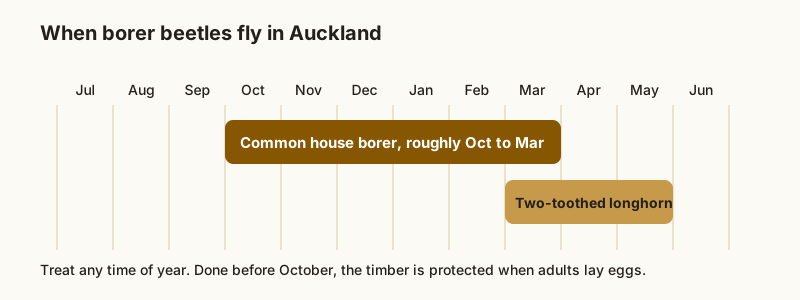
The two-toothed longhorn comes out later, in autumn, from about March to May. If you're planning a treatment, booking it before the flight season starts means the timber is protected when the adults come out and lay their eggs.
Are wood borers as bad as termites?
Wood borers are usually slower and less destructive than termites. Borer damage builds up over years, so you normally have time to treat it before the timber loses strength. Exotic termites are rare in New Zealand. They are a notifiable organism, which means you must report suspected termites to the Ministry for Primary Industries on 0800 80 99 66.
Signs that point to termites rather than borer, according to the Ministry for Primary Industries, include winged insects indoors, piles of discarded wings, and termite droppings. If you see any of these, report them before you treat anything.
Questions people ask
What are the best treatments for borers in New Zealand?
The best treatments for borers in New Zealand are a residual surface treatment on bare timber, flight-hole injection for painted or varnished wood, and fumigation or injection for furniture. Badly weakened timber needs replacing. Bombs and fogging only kill flying adults, so use them alongside a surface treatment during the flight season, not instead of one.
What kills borer in wood?
Borer in wood is killed by insecticides or preservatives that reach the larvae or stay on the surface long enough to catch the next generation. A residual treatment on bare timber does both over time. Injection pushes the product into the tunnels behind painted surfaces. Fumigation kills everything in a sealed item but leaves no lasting protection.
When should you spray for borer in NZ?
You can spray bare timber with a residual borer treatment at any time of year, because it keeps protecting the wood. Before or during the flight season, roughly October to March, is a good time, as that's when adults emerge and lay eggs. Bombs and foggers only work during the flight season, when the adults are flying.
How does Borer Wise work?
You tell us about the job in a short form, and a local borer specialist in Auckland gets back to you to ask a few questions and quote. You decide whether to go ahead. It's free to ask. How it works has the details.
Is borer common in Auckland houses?
Borer is common in many older Auckland houses, especially those with untreated timber in the subfloor and roof. It favours timber with some moisture, so damp subfloors and roof spaces with leaks are where it often starts. Many houses have old holes from borer that has died out, so checking for fresh activity matters.
Borer treatment in Auckland
- How to treat borer
How to treat borer in an Auckland home, step by step.
- Borer beetle
What the borer beetle looks like, how its life cycle works, which species get into New Zealand homes, and how to treat each one in Auckland.
- Home remedies
Vinegar, baking soda, kerosene, freezing.
- Borer holes
How to read borer holes and dust in your Auckland home.
- Costs
What borer treatment costs in Auckland in 2026: price ranges for roof voids, subfloors and whole houses, what changes the price, and what…
Sources
Last updated