Most home remedies for wood borer don't work on a house. Vinegar, baking soda and essential oils sit on the surface and soon wear off. The house borer larvae live deep in the timber for years, so a remedy has to soak in and keep working that long. Freezing can save a small piece of furniture. For floors, a subfloor or a roof void, you need a residual borer treatment. This page is part of our guide to borer treatment in Auckland. It explains which remedies help, which don't, and how to treat borer in a house properly.
Do home remedies for wood borer work?
Home remedies for wood borer rarely work in a house. The common house borer beetle lays its eggs on bare timber, and the larvae then tunnel inside for two to four years. A remedy that doesn't soak in, or that stops working within weeks, misses almost all of them. Fixing damp and freezing small items are the two home methods that do help.
Here's how the common remedies compare:
| Remedy | Does it reach larvae in the wood? | Does it keep protecting? | Verdict |
|---|---|---|---|
| Vinegar | No | No | Doesn't stop an infestation |
| Baking soda | No | No | Doesn't stop an infestation |
| Essential oils | No | No | Doesn't stop an infestation |
| Kerosene or turpentine | Only where it's injected | No | Flammable, smelly, not suitable indoors |
| Fly spray | No | No | Kills a beetle you can see, nothing more |
| Freezing (small items) | Yes | No | Works for furniture, but slow and can damage it |
| Fixing damp and ventilation | Indirectly | Yes | Worth doing every time |
Freezing is the one homemade method with good support. A small item kept frozen for two to three weeks kills the larvae, though it can damage some finishes and glues. It gives no protection afterwards, so treat the bare wood once it has thawed and dried.
Does vinegar or baking soda kill wood borer?
Vinegar and baking soda don't kill wood borer in any useful way. They might kill a larva they touch directly, but they don't soak deep into the timber, and they don't leave anything behind to stop the next generation. Borer larvae live far from the surface, which is why you need a long-lasting residual product.
People often try these remedies because they want to avoid chemicals in the house, and that's a fair goal. It's better met by treating only the timber that's active, choosing a product made for indoor use, and following the label, than by spending a season on a remedy that leaves the borer feeding.
Does kerosene or turpentine kill borer?
Kerosene and turpentine can kill a larva if they're injected straight into its tunnel. They evaporate, though, and leave no lasting protection, so the next generation of eggs is untouched. Both are flammable and give off strong fumes, so they're a poor choice for floors, framing or furniture inside a house. A borer injection product made for the job is safer and keeps working.
How to tell if borer is active in your house
Borer in your house is active if you see fresh holes with clean, pale edges, fine powder that comes back after you clean it up, or small brown beetles near windows in the warmer months. Old holes with dark edges and no new dust often mean borer that has died out. Check the subfloor, roof void, floorboards and any untreated timber.
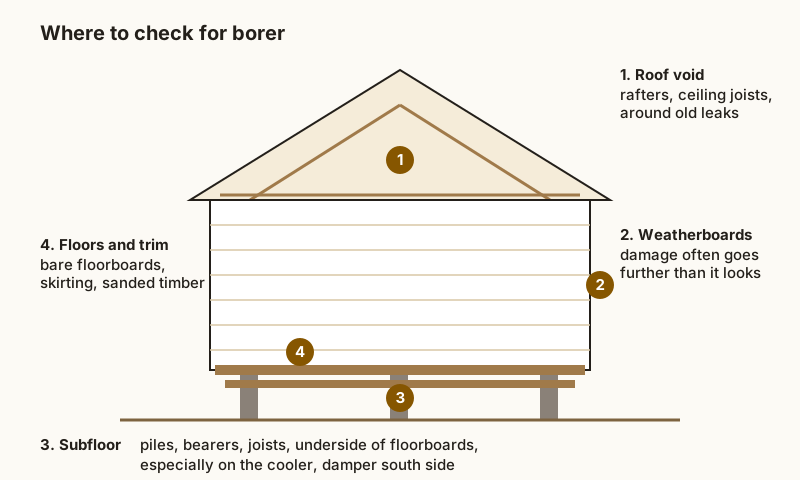
Where to look in Auckland homes and other timber buildings:
- The subfloor: piles, bearers, joists and the underside of floorboards, especially on the cooler, damper south side.
- The roof void: rafters and ceiling joists, around old leaks.
- Floors and trim: bare floorboards, skirting and timber you've sanded back.
- Weatherboards: Consumer NZ warns that borer in weatherboards often means the damage goes further than it looks.
- Furniture: older pieces of untreated pine or native timber.
To test, vacuum away the powder, or put masking tape over a few holes, and check again over the next flight season. New powder or broken tape means live borer. Our page on borer holes shows what the damage looks like.
How to treat borer in a house
To treat borer in a house, confirm where it's active, then put a residual borer treatment on the bare timber there. Inject the flight holes in painted or varnished wood. Use bombs or fogging in the roof void or subfloor during flight season only as an extra step. Replace any timber that has gone soft. Large areas and hard-to-reach spaces are usually best left to a professional.
The order that works:
- Find the damp and fix it. Borer prefers timber with some moisture. Ventilate the subfloor, clear vents and fix leaks in the roof and plumbing.
- Treat the bare timber in the subfloor and roof void with a residual spray.
- Inject flight holes in floors, trim and furniture that have a finish.
- Add a bomb or fogger during flight season if you want to knock back the adults.
- Check every flight season for new holes.
The subfloor and roof void are where most house borer lives, and they're the hardest places to work. You lie in a tight, dusty space with a sprayer and a respirator, around insulation and wiring. That's when it's worth comparing quotes. Our guide on how to treat borer has the full method.
Questions people ask
Can you get rid of borer in a house?
Yes, you can get rid of borer in a house. A residual treatment on the bare timber, flight-hole injection on painted wood and fixing the damp will end most infestations. Borer that has gone untreated for years may have weakened some floors or framing, and that timber needs replacing. Checking again each flight season confirms the treatment worked.
What is the furniture beetle?
The furniture beetle is another name for the common house borer, Anobium punctatum. In the United Kingdom it's called the common furniture beetle, and its larvae are known as woodworm. In New Zealand the same beetle attacks floors, framing and furniture made from untreated softwood and sapwood. It leaves round holes about 1 to 2 mm across.
What are wood borer droppings?
Wood borer droppings, called frass, are the fine, gritty powder you find under borer holes. It's wood that the larvae have chewed and passed through as they tunnel. Fresh frass is pale and builds up again after you clean it away, which tells you the borer is active. Old, dark frass that doesn't return usually means borer that has died out.
What kills wood borer naturally?
No natural product reliably kills wood borer throughout a house. Freezing kills larvae in small items of furniture if they're kept frozen for two to three weeks. Keeping timber dry makes it much less attractive to borer. For floors, framing and roof timber, a residual borer treatment is the only option that both reaches the larvae and keeps protecting the wood.
Is it safe to treat borer myself?
Treating borer yourself is safe for small, easy jobs if you follow the product label, wear gloves and eye protection, and keep the space ventilated. Spraying a subfloor or roof void is harder. Those spaces are tight and dusty, and the label usually calls for a respirator and protective clothing. Many people pay a professional for those parts.
Sources
Last updated